


Pico Laser Before and After: Real PicoSure Results Toronto
Real PicoSure before and after photos from our clinic, what one session and a full course can do, and how to protect your result.

Key Takeaways
- Pico laser results depend on the diagnosis: sun spots and freckles often clear in 1–3 sessions, while melasma is managed, not cured.
- One session can clear a small, flat sun spot, but acne marks, melasma and acne scars need a course of sessions.
- Treated spots darken and flake off over 7–14 days, and each session's result is judged at about 4–6 weeks.
- Asian and darker skin can be treated safely when the energy suits your skin type and a test spot comes first where needed.
- Daily SPF 50+ and gentle aftercare protect your result, and Dr. Dan Xu and our team plan every course at our Markham clinic.
Direct Answer
Pico laser before and after results depend on what your pigment is. Sun spots and freckles often fade clearly in 1–3 sessions, acne marks need 3–5, and melasma is managed over 4–6 gentle sessions plus maintenance. Treated spots darken, then flake off within about two weeks. Dr. Dan Xu and our team plan every PicoSure Pro course after examining your skin.
What PicoSure before-and-after photos can and cannot tell you
A before-and-after photo shows what one treatment plan did for one person’s skin. It is a helpful guide to what is possible, but it is not a promise for your own skin.
Pico laser before and after photos are the first thing most people ask to see. A pico laser breaks pigment into tiny pieces with bursts of light that last trillionths of a second, and your body clears the pieces. At our Markham clinic, Dr. Dan Xu and our team use PicoSure Pro pico laser treatment for most spots, acne marks and texture concerns. Before you look at the photos, keep three things in mind.
1. Most results come from a plan, not one device
Many pigment plans also include skin preparation creams and sometimes a second laser. Giving one laser all the credit would overstate what it did, so our case records list every treatment used.
2. The diagnosis decides how much change is possible
A sun spot and melasma (hormone-driven brown patches) can look alike in a photo, but they behave very differently. Sun spots often clear and stay clear with daily sunscreen. Melasma is managed rather than cured, and it can return with sun, heat or hormones. A dramatic photo of one is not a forecast for the other.
3. Your number of sessions is set at your assessment
How many sessions you need depends on how deep the pigment sits, your skin type, what triggers it and how your skin reacts to the first session. When there is any doubt, we treat a small test spot first. The ranges in this guide are typical, not fixed.
PicoSure before and after: Dr. Xu’s real cases
These PicoSure laser before and after photos are unretouched clinical records of our own clients. Every client signed a written media release. Results vary with the diagnosis, your skin type and the plan used.
Many of our pigment cases combine more than one laser. A common plan pairs PicoSure Pro with PicoWay, which we call Dual Pico, and some plans add a light treatment such as BBL. So these photos show pico laser results in general, not PicoSure alone.
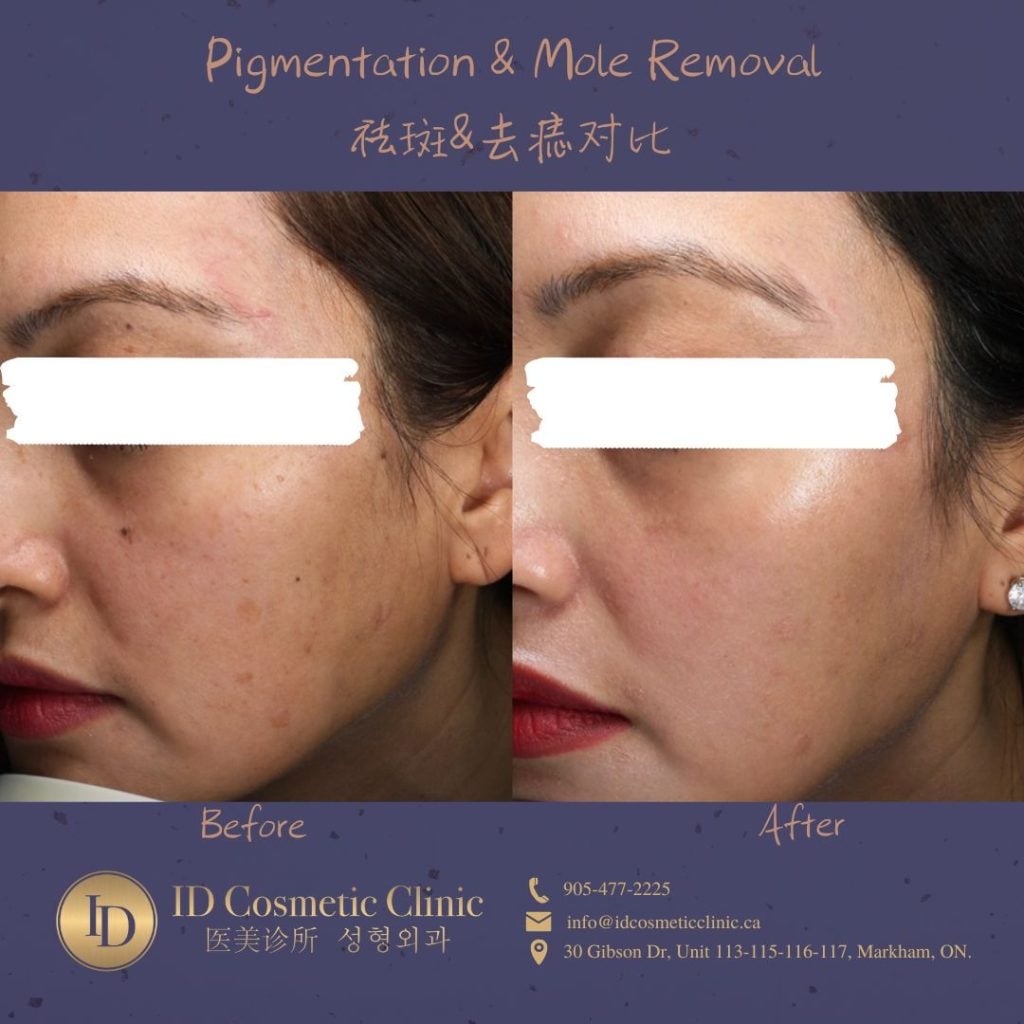


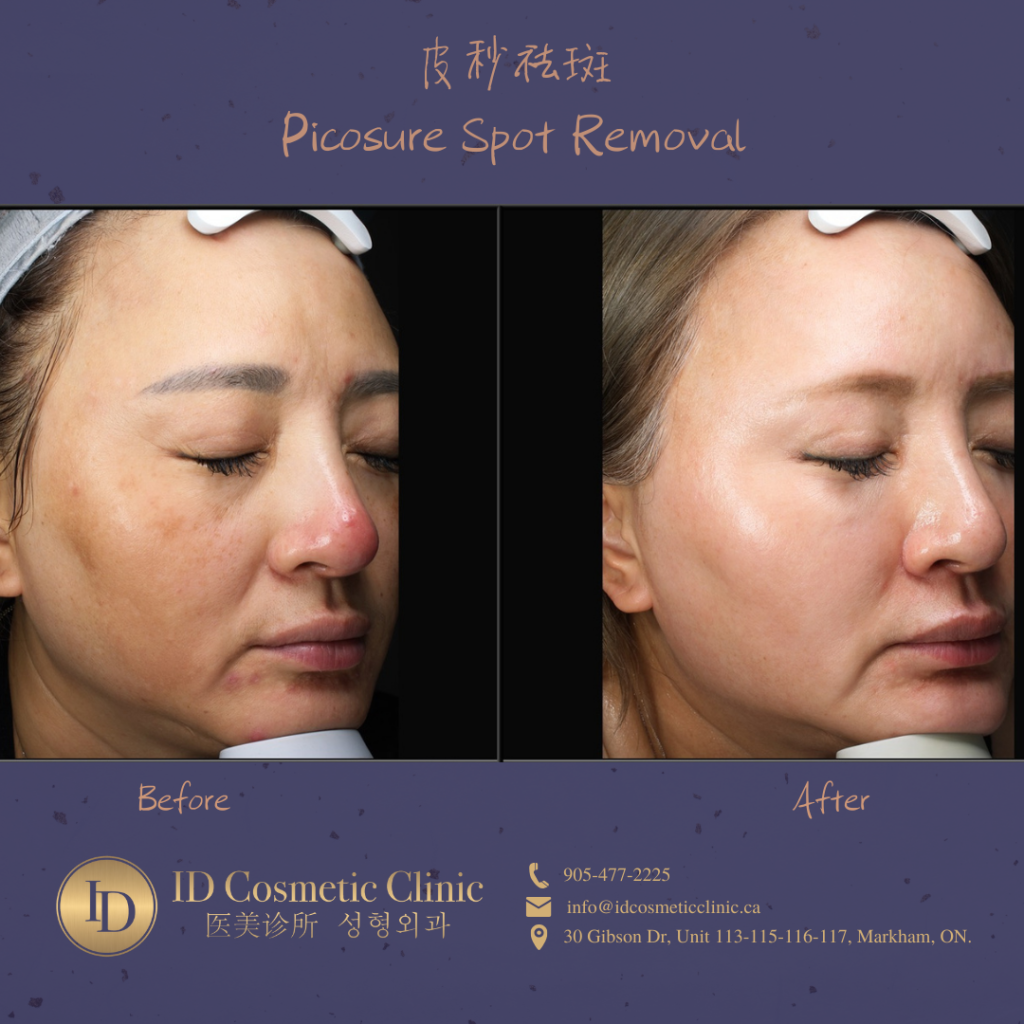
For more pico laser hyperpigmentation before and after photos, with the treatments listed for each case, see our results for hyperpigmentation, melasma, freckles and age spots and sun spots.
PicoSure Pro before and after: results by skin concern
What your “after” looks like depends on what the pigment or scar is. Flat sun spots and freckles change the most and the fastest, while melasma, deeper pigment and acne scars change slowly over a course.
Most pico laser face before and after photos show one of the concerns in this table. It sums up what we usually see with PicoSure Pro and PicoWay; your own plan is set after Dr. Xu examines your skin.
| Concern | Typical sessions | Weeks apart | What a good “after” looks like |
|---|---|---|---|
| Sun spots and age spots | 1–3 | 4–6 | Spot darkens, flakes off, then is gone or much lighter |
| Freckles | 1–2 | 4–6 | Clearly lighter; new freckles can form with sun |
| Acne marks (PIH) | 3–5 | 4–5 | Marks fade a little more after each session |
| Melasma | 4–6 gentle sessions, then maintenance | 4–6 | Lighter, softer patches; managed, not cured |
| Hori’s nevus (deeper pigment) | 5–8, mainly PicoWay | About 8 | Grey-brown dots fade slowly over the course |
| Acne scars and texture | 4–6 | 4–6 | Smoother skin and softer scars, building over 3–6 months |
Sun spots and age spots
Flat brown sun spots respond most reliably. Each spot turns darker for a few days, then flakes off with tiny crusts within about two weeks. They stay away if you protect your skin from the sun. Our page on laser dark spot removal explains which spots suit a laser.
Freckles
PicoSure freckle removal often takes only 1–2 sessions. Pico laser for freckles before and after photos usually show clearly lighter freckles within a couple of weeks. Freckles run in families and react to sunlight, though, so new ones can appear each summer. Daily sunscreen and an occasional touch-up keep the result.
Melasma before and after, and pico toning
Melasma is managed, not cured, so an honest melasma before and after shows lighter, softer patches rather than clear skin. We use low energy over 4–6 sessions, together with creams such as Cyspera or tranexamic acid and strict sun protection. Too much heat or sun can make melasma flare, which is why the settings stay gentle.
“Pico toning” means gentle, low-energy passes over the whole face to even out tone, instead of strong pulses on single spots. Our guide to PicoSure Pro vs PicoWay for melasma explains how we choose the laser.
Hori’s nevus and pigment under the eyes
Hori’s nevus shows as grey-brown or blue-grey dots on both cheekbones. It sits deeper in the skin than a sun spot and is often mistaken for melasma. It usually needs PicoWay’s deeper-reaching 1064 nm wavelength, often within a Dual Pico plan.
A pico laser under the eyes can lighten brown pigment there. Dark circles caused by hollows, thin skin or visible veins are not pigment, so a laser will not change them. Dr. Xu checks which type you have before suggesting a plan.
Acne marks (post-inflammatory hyperpigmentation)
Acne marks are flat brown or dark marks left where pimples healed. Doctors call them PIH, short for post-inflammatory hyperpigmentation. They fade a little more after each low-energy session. Active acne is calmed first, because new pimples leave new marks.
Acne scars and skin texture (fractional pico)
PicoSure laser for acne scars works differently from pigment treatment. The Focus lens on PicoSure Pro, and the Resolve lens on PicoWay, split the beam into many tiny points of energy. These make small zones of repair under the surface, which is why people call it fractional pico. Your skin answers by making new collagen.
In honest pico laser acne scars before and after photos, look for softer, shallower scars and smoother texture, not scar-free skin. The change keeps building for 3–6 months after the last session. Rolling and boxcar scars respond better than deep, narrow icepick scars, and we often combine pico with microneedling.
Body areas and tattoos
Pico lasers also treat sun spots on the hands, chest and legs. Darker skin on the underarms and inner thighs, near the intimate area, usually comes from friction, shaving or hormones, and it lightens slowly over several low-energy sessions. Because Dr. Xu is a medical doctor, your consultation also checks for causes such as insulin resistance first.
Tattoo removal follows its own, longer timeline. Our guide to PicoWay laser tattoo removal covers it.
Pico laser before and after 1 treatment: what one session can do
One session can clear a small, flat sun spot or clearly lighten freckles. For most other concerns, one session gives a partial change, and the full result needs a course.
Many pico laser before and after photos online show one session on a surface spot, the concern most likely to change in one visit. PicoSure results after one treatment are much smaller for melasma, acne marks, Hori’s nevus and acne scars.
Judge your first session at about 4–6 weeks, not in the first week. In the first days, treated spots look darker on purpose, so a “day 3” photo can look worse than your starting point. By week 4–6 the crusts and redness have gone, and you can fairly compare it with your before photo.
Here is what one session usually does, compared with a full course.
| Concern | After 1 session | After a full course |
|---|---|---|
| Small, flat sun spot | Often gone or much lighter | Gone; stays away with daily SPF |
| Freckles | Clearly lighter | Mostly cleared; new ones can form with sun |
| Acne marks | Slightly lighter | Much lighter, with a more even tone |
| Melasma | Little visible change | Lighter patches that need maintenance |
| Acne scars | Skin feels smoother; small visible change | Softer scars 3–6 months after the last session |
What to expect after pico laser, day by day
Expect redness for a few hours and darker spots for the first few days. Fine flakes then fall off within about 1–2 weeks, and most people go back to work the same day.
The table shows a typical path after one PicoSure or PicoWay session for spots and pigment. Texture and scar treatments follow a slower path, because collagen keeps building for months.
| When | What you see | What to do |
|---|---|---|
| Right after | Redness and warmth; treated spots may turn white for a few minutes | Keep the skin cool; no makeup on treated areas |
| Days 1–3 | Spots look darker, a bit like coffee grounds; skin may feel rough | Gentle cleanser, moisturizer and SPF 50+ |
| Days 4–10 | Fine dark crusts lift and fall off by themselves | Do not pick or scrub |
| Weeks 2–4 | Lighter skin shows and any pinkness fades | Keep up daily sunscreen |
| Weeks 4–6 | A fair time to compare with your before photo | Review with Dr. Xu and plan the next session |
| 3–6 months after your last session | Full result, as the last pigment clears and collagen rebuilds | Maintenance if you need it |
So how long does PicoSure take to work? You usually see the first lightening within 1–2 weeks, and the full result 3–6 months after your last session.
Darkening in the first week is expected. It shows the laser reached the pigment, which is now rising to the surface to shed. New darkening that appears 2–6 weeks later is different, because it can be PIH. Call our clinic if you notice it, so Dr. Xu can check your skin and adjust the plan.
Video: your skin right after a PicoSure or PicoWay session
This short video shows what skin looks like in the minutes after treatment. It helps if you are planning around an event.
How we take and judge before-and-after photos
A fair pair of photos uses the same room, light, angle and distance, with no makeup, filters or retouching. The “after” photo is taken once healing is complete, not in the first week.
We photograph your skin at your first visit and again at follow-up visits, in the same pose and lighting. Our photos are unretouched clinical records, and we share them only with a client’s written consent.
When you look at any picosecond laser before and after photos, also check these points:
- The right timing. Spots are judged 4–6 weeks after a session, and scars or texture 3–6 months after the course.
- Side lighting for scars. Light from the side shows scar depth that flat light hides.
- The full plan. A good case says which treatments were used and how many sessions.
Why pico laser results differ from person to person
Pico laser results differ mainly because pigment differs: its type, its depth and what keeps triggering it. Your skin type, sun habits and aftercare matter too.
- Type and depth of pigment. Surface spots clear faster than deep pigment such as Hori’s nevus.
- Triggers. Hormones, sun and heat keep feeding melasma, so it can return.
- Skin type. Medium and darker skin needs gentler settings, so progress is steadier and slower.
- Number of sessions. Stopping after one or two sessions often leaves a partial result.
- Aftercare. Sun on healing skin, or picking at crusts, can leave new marks.
Pico laser before and after on Asian, brown and dark skin
Pico lasers suit Asian, brown and darker skin when the energy matches your skin type. The main risk is post-inflammatory hyperpigmentation (PIH): new darkening that can appear a few weeks after treatment.
Pico pulses carry less heat than older nanosecond lasers, and heat is what stirs up pigment cells in medium and dark skin. That is why pico is the usual choice for pigment in Fitzpatrick III–V skin. (The Fitzpatrick scale describes how easily your skin burns or tans.)
Before your first full session, three checks come first:
- A Wood’s lamp exam, which uses a special light to show how deep your pigment sits.
- Fitzpatrick skin typing, to set a safe energy level.
- For Fitzpatrick IV–VI skin, a test spot first, often after about 6 weeks of a skin preparation cream.
PIH usually fades over a few months, but preventing it is far better. Lower energy, enough time between sessions and strict sun protection keep the risk low. In our experience, most darkening problems come from sun on healing skin or settings that were too strong.
Every spot is checked before it is lasered
Because Dr. Xu is a medical doctor, your consultation also checks every spot before any laser. A spot that is raised, growing, bleeding, itchy or uneven in colour is not lasered until it has been examined. Our pigmentation laser page explains how the diagnosis decides which laser we use.
Aftercare that protects your pico laser result
Good aftercare is simple: be gentle, leave the crusts alone and wear sunscreen every day. That is what keeps new marks from forming while your skin heals.
First 48 hours
- Wash your face gently with a mild cleanser and lukewarm water. You can shower, but keep hot water off the treated area.
- Use only a gentle moisturizer for the first 24 hours, and no makeup on treated areas.
- Skip saunas, hot yoga, hard workouts, hot showers and alcohol for 48 hours.
First week
- Wear SPF 50+ every day, even on cloudy days, and a hat outdoors.
- Pause retinol, AHA, BHA and vitamin C for 5–7 days. Plain hydrating products, such as hyaluronic acid, are fine.
- Let crusts fall off on their own. Do not pick, scrub or exfoliate.
- You can usually wear makeup again the day after a facial treatment.
After the first week
- Keep using daily SPF for at least 3 months.
- Use any prescribed cream, such as Cyspera for melasma, as directed.
- Return to your usual skincare, including niacinamide, once your skin feels calm.
Call our clinic if you notice blisters, oozing, redness that gets worse instead of better, or new dark patches a few weeks later. We would rather see you early.
Who should wait before pico laser
Most healthy adults can have pico laser, but some people should wait or need a different plan. Dr. Xu checks all of this at your consultation.
- You are pregnant or breastfeeding.
- You have an active skin infection, cold sore or open wound in the area.
- You took isotretinoin (Accutane) in the past 6 months.
- You have a fresh tan, or strong sun exposure in the past 2–4 weeks.
- You take a medicine that makes skin sensitive to light and cannot pause it.
- You tend to form keloids (raised, thick scars).
- You have an autoimmune condition that affects the skin, such as vitiligo.
- Your acne or melasma is flaring right now; we calm it first.
Fall and winter are easier seasons to start, because there is less strong sun while your skin heals. If you have a beach trip coming up, book your session at least 2–4 weeks before you leave, or wait until you are back.
Is PicoSure worth it? How to plan your own result
PicoSure is worth it when your concern matches what pico lasers do well: sun spots, freckles, acne marks, texture and, with care, melasma. It is less worth it if you expect one session to clear melasma or deep scars.
Your first step is a free 30-minute consultation at our Markham clinic. Dr. Xu examines your skin, explains what an honest “after” looks like for you and confirms the price for your whole course before you book. If your pigment sits at more than one depth, your plan may combine PicoSure Pro and PicoWay.
Frequently Asked Questions
Frequently Asked Questions
How much does PicoSure laser treatment cost in Toronto?
In Toronto, a full-face PicoSure Pro session generally costs CAD $500–800, and a spot or small area $250–400 per session. Most concerns need 3–6 sessions, so a full-face course usually comes to $1,500–4,800. Dr. Xu confirms the price for your whole course at your free consultation, and our PicoSure Pro cost guide explains what changes the price. Prices are for reference only and reflect general Toronto pricing. Please contact us for your exact price.
Does PicoSure really work?
Yes, for the right concern. It works well on sun spots, freckles and acne marks, and it softens acne scars and improves texture over a course. Melasma improves too, but it needs ongoing care. Results vary, and Dr. Xu tells you honestly at your consultation whether PicoSure suits your skin.
How does PicoSure laser work on acne scars and pigmentation?
PicoSure fires pulses of light that last trillionths of a second (picoseconds). The pulses shatter pigment into tiny pieces with a pressure wave and little heat, and your body clears the pieces. For acne scars, the Focus lens splits the beam into tiny points that trigger new collagen and elastin under the surface, so scars soften over a few months.
Does PicoSure laser hurt?
Most people feel quick snaps, like a rubber band, and rate it about 2–4 out of 10 with numbing cream. Our team applies the numbing cream for about 20 minutes first, and the whole visit takes 30–45 minutes. Tattoo sessions feel sharper. Redness and warmth usually settle within a few hours.
How long do PicoSure results last? Are they permanent?
Results last as long as the cause stays under control. A cleared spot is gone, but sun can bring new spots and freckles to the same area. Melasma is long-term and can return with sun, heat or hormones. Daily SPF 50+ and a maintenance plan help you keep your result.
How often should I get PicoSure for maintenance?
After your course, many people book a low-energy maintenance session every 3–6 months, mainly for melasma or if they spend a lot of time outdoors. People treated for a few sun spots may only need a touch-up when new spots appear. Dr. Xu sets your schedule based on how your skin responds and your sun habits.
What are the side effects of PicoSure, and can it make pigment worse?
Expected effects are redness, mild swelling and spots darkening before they flake off, all within the first one to two weeks. Less often, pigment gets darker a few weeks later (PIH), or a spot heals a little lighter; both usually fade over months. Melasma can flare if the energy is too high, so we keep settings low and use test spots for darker skin. Blisters, infection and scarring are rare.
Can I combine PicoSure with other treatments?
Yes, but the timing matters. PicoSure Pro pairs well with hyaluronic acid skin boosters, Thermage and Botox, and prescription lightening creams are often used between melasma sessions. Botox and fillers are usually scheduled before, or well after, a laser session. Dr. Xu plans the order so one recovery does not overlap with the next.
What is the difference between PicoSure and PicoWay for acne scars?
Both are pico lasers that improve acne scars by triggering new collagen. PicoSure and PicoSure Pro (Cynosure) use a 755 nm alexandrite wavelength with the Focus lens. PicoWay (Candela) uses 1064 nm and 532 nm, plus 785 nm, and its Resolve lens works in a similar way. We have both, so Dr. Xu can choose one or combine them; our PicoSure vs PicoWay guide compares them in detail.
Is PicoSure laser authorized in Canada?
Yes. PicoSure by Cynosure holds FDA clearance in the United States and is also authorized for use in Canada under Health Canada's medical device regulations, classified as a Class II or higher medical device depending on its application. At our Markham clinic, Dr. Dan Xu and our team use PicoSure Pro, Cynosure's newer pico laser.
Next Step
Ready to Take the First Step?
Laxity, wrinkles and facial sagging have different root causes — one physician-led consultation identifies the true problem layer before deciding which plan fits you best.

